Monday, 10 November 2014

AIR ... Grille, Splitter, Diffuser, Skirt, Spoiler, Wing

AIR
This free gift of nature is everywhere and is used for a whole lot of things.
It plays a lot of roles in our lives. These could be negative or positive roles in the car's life.

Cooling
Its majorly in traffic that we get to see cars overheat,


this is as a result of heat build up in the engine and the failure of the radiator to disperse the heat. This dispersal is made possible thanks to the air blown on the radiator by its fan.

Wonder how the fan gets air to blow?
Through inlets in the vehicle's body. These inlets are called...
"Grilles".
The most common grille is the opening we see at the front of the car (its gotta breathe too you know)


Which doesn't just let air into the engine compartment but also tells us who its maker is as majority of them bear their maker's LOGO


some car makers even have "trademark-like" grilles.
Such as

BMW's Split kidney Grille

*Birdman's shoe on the "Horse Shoe" Grille of his Bugatti*


Rolls Royce's Vertical bars on Grille


to name a few.

As mentioned earlier, the grille isn't just that opening at the front of the car.
It's also the air inlets for the cooling of the brakes (which can produce quite an enormous amount of heat)


Lift
The faster we go, the lighter the car seems to get,"ryt"? and
You also remember slowing down drastically after a fast straight to go round sharp bends so that you don't get thrown off the road? AIR playing games with us.
(Would explain in detail later)

Anyhows, to reduce these negative effects of air, some cars are fitted with special "aeorofoils" to provide "downforce" and "reduce drag".

*Downforce: Downward thrust of the car, allowing the car tackle corners at high speed.
*Drag: Air resistance, this gives the car more to fight against leading to more fuel consumption.

Splitter
This is situated at the foremost part of the front bumper. It splits the air from the front and sends most above the car at high pressure and channeling the rest at low pressure (high velocity) underneath the car.
The reaction of the high pressure above the car and the low pressure underneath it creates downforce.


Diffuser
This is situated at the rearmost part of the car's under body. It simply slows the low pressure air from the bottom of the car and sends it out the rear at an angle that creates downforce.


Side Skirts
These are worn on the sides of the car to help channel the low pressure air to the rear of the car while keeping out as much high pressure air as possible


Spoilers
Located on the boot of a car. Its literally used to spoil the bad air that builds up at the rear of a moving car by "correcting" it as much as it can. Assists in reducing drag (better fuel efficiency)


Rear Wing
located on the same spot as the spoilers but more pronounced and helps in downforce creation.


Diffuser and Massive Rear Wings on an Audi R8


*The spoiler and rear wings are normally thought to be the same, they aren't as they have different functions and sizes.
*Neither of them increases vehicle speed.

On some cars they are flush with the vehicle body and deployed when needed or at will of the driver.


Sunday, 2 November 2014

Manual, Automatic, Semi-automatic, Manumatic Transmissions and Shift Paddles

What is a transmission?
Simply put
It's the system that converts the power from the engine into motion via multiple gears through the wheels (tyres' traction with the road).
Switching through these gears can be done in 2 major ways:
The Manual Transmission:
This was the first of the 2.
To select a gear, the driver FIRST has to disengage the engine from the transmission (by pressing the clutch pedal with the left foot and holding it down) to enable the desired gear's manual selection (with the use of a gear stick/shift lever) after which the engine is re-engaged (by getting the foot off the pedal)
* A learner here would need luck not to roll into the car sniffing his rear on the slightly steep slope at Unilag's back gate if suddenly made to halt just at the tip.


The Automatic Transmission:
This was developed after the manual transmission to enable seamless continuous gear selection without a clutch pedal or tasking the driver to manually select the right gears continuously to vary speed.

All you have to do after leaving the gear stick in the required gear (R, N, D ,S*) is release the brake (the middle pedal which you had pressed to release the gear from P) then press throttle (right pedal) as desired.

When either 1 or D1, 2 or D2, 3 or D3 etc written below the "D" in some automatic gearboxes is selected, the car instructs its "internal" gear selector not to venture into a gear higher than that selected gear.
*the gears e.g 2, D3 etc is the same gear in its manual counterpart.

You might be asking yourself "Why would I need to restrict my gear movement? Hang around, #T_A_P_ has the answers.
Comparisons
- On our more than often congested Nigerian Roads, you would experience less stress with the auto as you do not ask/require anything of your left leg.
- Want to save some Naira? Go for the manual option as its cheaper to buy and maintain. Bearing in mind that ...
- ... if you have not grabbed the "clutch/throttle-release/press" technique (skills which an increasing amount of new, sometimes lazy Nigerian drivers lack). Your clutch repair costs would be "obtaining" you regularly.
("obtaining" taking place)

* On the bright side, in a race, if gear shifting is done properly, manuals feed their auto counterparts DUST.

BONUS: More stunts are available in the "MANual Stunts Handbook" as less power (from the engine) is lost to the transmission system.
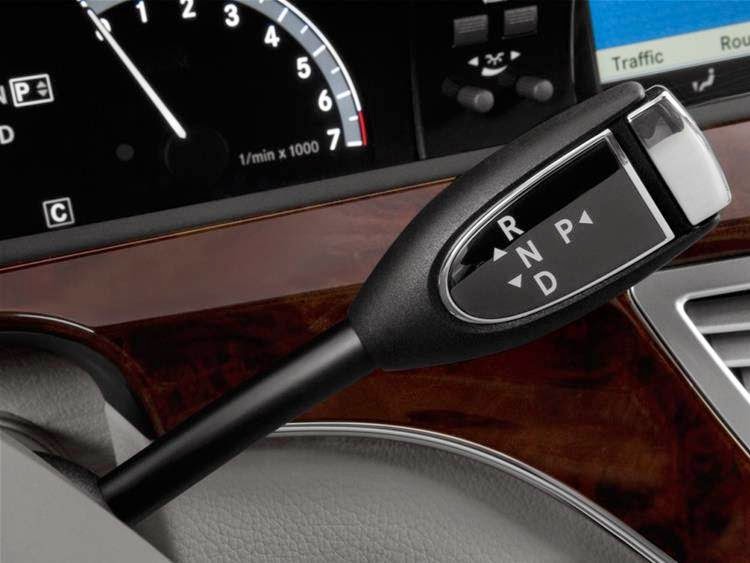
Apart from the regular gear stick which is normally located in the center console or on the steering column

We also have the rotary gear selector

and the push button gear selectors in some cars


A blend of both would be best for YOU?
Then you have nothing to fear, Semi-Automatics and Manumatics are here!!!
This is the harmonization of manual and automatic with the elimination of their major flaws.
Now, the clutch pedal as in the manual (a "seeming" flaw) has been eliminated and the auto which deprives the driver of the ability to manipulate gear change at will (especially in times of performance need) has been replaced by a "sequential" gearbox, sometimes accompanied by shift/flappy paddles mounted behind the steering wheel.

These "flappy paddles" allow the driver downshift (-) by tapping the left steering mounted paddle towards self and upshift (+) by doing same to the right one.

With the sequential gearbox, "gears" can't skipped, they must follow a sequence 1,2,3,4,3,2,3 etc.


To use, driver pushes the gear stick right at "D"  (or left depending on car) to gain access to the sequential gear selector and taps it up or down for upshifts and downshifts respectively. 
When the offspring has either more of the man or auto's DNA, it's called a "semi-automatic" or a "manumatic" respectively.
Semi-automatic transmissions can be found in high performance cars like the Mercedes-Benz E63 AMG and the BMW M5


 while some of their less powerful siblings which belong to the mainstream line up such as the Mercedes-Benz E350, E500 etc and the BMW 530i, 535i etc are fitted with Manumatic transmissions.


*WARNING!!!
They might look similar but ONE is "A Wolf in Sheep's Clothing".
(For the serious car lovers, would go deeper into TRANSMISSIONS later)
For alerts when new articles are posted and to show your support... Follow @Asphalt_Project on twitter
Contact:                                                                                             theasphaltproject@yahoo.com                                                   theasphaltproject@gmail.com                                                                                           BBM: 2B9B8450
If you've "enjoyed" this or any other article on this blog , please do not hesitate to share the pleasure with others via any of the share options available and however else you can.

Thursday, 30 October 2014

Tire or Tyre?

As we all know, the spelling of some words differ due to American and British English so both Tire and Tyre are respectively right.

A tyre/tire is a rubber covering, placed around a wheel to form a flexible contact with the road.


American rapper, The Game sitting on a tire wrapped around a gold spoked rim/wheel (Nigerian artistes don't seem to have clean enough tyres to sit on)

As large as a car may be, the only thing connecting it to the road is the tyres. The perturbing thing is, just a little part of the tyre makes contact with the road at a time,The Contact Patch.

Tyres are a critically yet largely ignored component of any car. Attention is only paid when it brings our cars to a halt (hopefully only our cars).
This is an avoidable gamble.
For those who are fortunate to own (buy,rent or even steal) brand new cars. The brand new tyres come as default, so for the next couple of months or years they wouldn't need replacing. Noticed I said months?

Lifespan of a tyre
Well that's because there isn't any specific time or period within which tyres must be changed, it all depends on usage. Some people can cover 50,000km in 6 months, others would cover same in 6 years (not forgetting that some of us can't resist the slightest opportunity to burn rubber).

Not saying that tyres die but the rubber starts to degrade some years after its manufacture regardless of whether they have been put to use or not. When this happens, it loses its flexible properties, the treading is more prone to breakage when the powerful forces from hard acceleration,braking,cornering and maneuvering come into play.
In summary,a general nightmare.

                                                           
When should tyres be changed?
It's advisable to change all tyres at once and most importantly,with the same brand.

What difference does it make?
Tyres of different brands and sizes affect efficient braking. This goes without saying, it is incredibly dangerous.
Also, it affects the Tyre Pressure Monitoring System (TPMS)causing car performance to be severely altered.

Maintenance Tips
*Periodically Rotate your Tyres
This is the practice of moving the tyres from one position to another, this allows the tyres wear evenly and saves you money by delaying replacement. (would soon explain how this is done properly because of the pattern and type of tyres)

*Maintain The Right Tyre Pressure
You can check your tyre pressure with a tyre pressure guage


The max pressure a tyre can be inflated to is written on the sidewall. e.g MAX. PRESS. 44PSI


DO NOT TO INFLATE MORE THAN THIS NUMBER! as excessive pressure increases the chances of puncture from all the "stones" used to fill potholes in some parts of our Wonderful Nigeria,although close to or at this pressure decreases tyre wear and gives the driver a better feel of the road as the tyres send majority of the road force to the suspension BUT that could take its toll on the suspension if its not built for performance.

Meanwhile,low tyre pressure reduces fuel efficiency and an increase in tyre wall movement which can be detrimental during an emergency maneuver. On the bright side, when going off-road, the tyre pressure is sometimes lowered resulting in wider contact with the ground and reduces chances of getting bogged down.

Whats the right Tyre Pressure for your Car?
Its written on a sticker on the driver's door on some cars. It's also found in the owner's manual.

More tyre tips and info coming up ....

Thanks for your time


Sunday, 12 October 2014

CAR LOGOS, BADGES, NAMES AND NUMBERS

Cars like some humans, have courtesy, they introduce themselves to us.  They do so via "the writing on the wall" (car body in this aspect).

When we see a particular car  we haven't seen before, especially one that doesn't bear much or any resemblance to previous or other models from its maker,  the first way the car introduces itself is by showing you the "logo" of its maker. Which is  easily spotted on the middle of the car (front and rear).


It's this logo that we use to recognize cars by their "surname" (calling car names is the way your name would be called from your driver's license, the surname comes before the first name)
The location of the logos aren't limited to the middle of the front and rear. Various auto makers place more logos at other various parts such as
-wheels


-steering


-gear stick 


-headrests and/or seats


-head lamps


-foot mats and a host of other places.

Logos help you recognize car brands.

Some makers have more than one means of identification e.g
Jaguar's pouncing jaguar


 Rolls Royce's Ecstasy.


Another way the car introduces itself is by showing you its "badges and numbers"
These badges tell you it's first name, and what it's "packing"

By First name, I mean what it's actually called which could be 
Corolla

CX-7

4008

 Evoque 


etc" And what it's packing simply means what it's got under its hood (the way tight fitting attires give onlookers an idea of the "merchandise") such as  its displacement (1.8 or 2.5, simply tells you that it's cylinders would inhale 1.8 or 2.5 liters of "air" for it to rotate the crankshaft twice). I'm sure you are wondering; "air", isn't it meant to be petrol? (stick around for that)

You are also informed about what "trim" (option, specs,package) level they belong to. The SE and LE on Toyota Camry's just tell you the SE is the "sport" option 


and the CE cries out to you that its the "base"(lowest) option therefore the cheapest of the pack. Luckily the CE isn't restricted from getting some of the optional packages available as standard on the XLE trim Camry. (would go deeper into that as well)

*They tell you their "valve timing": You see "vvt-i", "i-vtec" and "cvvt" on and not limited to Toyota, Honda and Hyundai vehicles respectively. Different car makers have their own valve timing technology names and want us to appreciate them as well. 
Therefore, the numbers and letters you see on the car bodies actually have uses being there.

Would interpret further as time goes by

Images: google, bing.

Thursday, 2 October 2014

Toyota Ten Facts


Here are 10 facts about one of the top selling car brands in Nigeria. 

10) Toyota Motor Corporation is 77 years old.


9) Toyota Exports to Nigeria commenced in February 1959
8) The luxury vehicle division of Toyota is Lexus. The original form of the name Lexus is Alexis.


7) A city in Japan, Koromo, renamed itself Toyota city, 22 years after the Founding of Toyota.


6) Toyota Corolla is the company's bestselling Automobile.


5) The Federal Road Safety Commission (FRSC) wrote Toyota over the safety of Hiace Buses after a spate of Accidents.


4) Saved by a war. Toyota was almost out of business until the US ordered 5,000 vehicles for the Korean War.


3) Toyota was involved in the creation of Kiribo, a Robot Astronaut.


2) Between Sept 2007 and Feb 2011, Toyota had a total of 17 major Vehicle recalls.


1) The Toyoda Family of Japan were originally Textile Manufacturers, they sold the patent of their automatic loom technology to the Platt Brothers of UK. The family invested the proceeds into the Automobile business.
The rest is history.


Funfact- The Toyoda Family maintain the Textile business till this day!


Please post your comments on topics or cars you wish to learn facts about.